Every first-time guest asks us the same question in a slightly different way. “Will I be able to post photos from the Mara?” “Can I call my kids from camp?” “Will I disappear off the grid for two weeks?”
The honest answer is: it depends on where you are, and we would rather tell you that plainly than sell you a vague promise. This guide covers Kenya safari SIM card internet connectivity in plain terms, camp by camp, park by park, so you can plan around it instead of being surprised by it.
Safaricom, Airtel, or Telkom: which network actually works in the bush
Kenya has three mobile networks: Safaricom, Airtel Kenya, and Telkom Kenya. For a safari, the choice is not really a choice. Safaricom built its towers to follow tourism routes and major roads first, so it has by far the widest reach into conservancies and park gates. Airtel has decent coverage in towns like Narok, Nanyuki, and Voi, but it thins out fast once you’re deep in a reserve.
Telkom is fine in Nairobi and barely worth mentioning outside it. For safari purposes, get a Safaricom line. Almost every driver-guide, lodge manager, and camp radio operator in Kenya uses Safaricom, which also means it is the network most likely to have a signal wherever your vehicle breaks down.
Buying a SIM card: airport, city, or before you land
You can buy a Safaricom SIM at the Jomo Kenyatta International Airport (JKIA) arrivals hall in Nairobi, at a counter usually staffed until late evening. You will need your passport. Kenyan law requires SIM registration, no exceptions. Agents cannot skip this step, even if you’re in a hurry to catch a connecting flight to the Mara.
Prices are modest. A basic tourist SIM typically runs KES 100 to KES 500 (roughly USD 1 to 4), sometimes bundled with starter data. If you land at night, or just prefer to sort logistics before you fly, there are other options. Safaricom’s eSIM and travel packages, plus options from Airalo and Holafly, let you activate a Kenyan or regional data plan before takeoff. An eSIM is simpler if your phone supports it and you don’t want to fiddle with a tray on arrival. It won’t help you make local M-Pesa mobile money payments the way a physical Safaricom number will, though.
If you’re still finalizing paperwork, this is also a good moment to sort your Kenya eTA before you go. That approval and your SIM setup are both easiest to handle before departure.
Kenya safari SIM card internet connectivity: SIM vs eSIM vs roaming, compared
| Option | Typical cost (2 weeks) | Needs passport at counter | Works for M-Pesa | Best for |
|---|---|---|---|---|
| Safaricom physical SIM | USD 5 to 20 in data bundles | Yes | Yes | Most travelers, longer stays |
| Safaricom eSIM (activated abroad) | USD 10 to 25 | No, registered online | Limited | Guests with eSIM phones, tight airport time |
| Airalo or Holafly eSIM | USD 15 to 35 | No | No | Data-only, quick trips, no calls needed |
| Home network roaming | Often USD 5 to 15 per day | No | No | Emergencies only, not recommended for 2 weeks |
Roaming looks convenient, but it adds up fast over a ten day trip. It will not help you tip a guide or buy a soda at a camp shop the way a local number does.
How much data do you actually need
For a one to two week trip mixing towns, lodges, and camps, we suggest budgeting 3GB to 6GB total if you mainly use WhatsApp, maps, and light photo sharing. Add more if you plan to video call home. Safaricom data bundles are cheap by most travelers’ standards, often around KES 1,000 (about USD 7 to 8) for several gigabytes valid for 30 days. Exact pricing shifts often, so treat this as an indicative range and confirm current rates when you buy.
Top-ups are easy once you’re set up. Load a small amount of M-Pesa mobile money credit at the airport or in Nairobi, and you can buy more data by dialing a short code from almost anywhere you have even one bar of signal.
Park by park: where you’ll have signal, and where you won’t
This is the part the generic guides skip. Coverage in Kenya is not a national blanket, it’s patchy and tied to specific towns, gates, and terrain.
| Park or reserve | Approx. distance from Nairobi | Typical drive time | Safaricom signal reality |
|---|---|---|---|
| Masai Mara National Reserve | 270 km | 5 to 6 hours by road, 45 min by air | Decent 3G/4G near Sekenani and Talek gates, patchy to none deep in conservancies |
| Amboseli National Park | 240 km | 4 hours | Reasonable signal near Kimana gate and lodges, weak in the open plains |
| Samburu National Reserve | 325 km | 5 to 6 hours | Weakest of the major circuits, spotty 2G at best in many spots |
| Tsavo East National Park | 330 km | 5 hours | Fair near Voi gate, drops off quickly further inside |
| Lake Nakuru National Park | 160 km | 2.5 to 3 hours | Generally reliable, closest circuit to Nairobi |
If your itinerary includes northern Kenya, read up on the Samburu circuit, where signal is weakest before you go. That way nobody panics when messages stop sending for a day.
Camp Wi-Fi and Starlink: the honest trade-off
Here’s where things get interesting. A growing number of camps, including some in the Mara and Laikipia, have installed Starlink satellite internet at the main lodge or mess tent. When it’s there, it genuinely rivals home broadband, fast enough for a video call with the office or a quick upload of that leopard photo.
But it is not everywhere, and it is rarely in your actual tent or room. Expect Wi-Fi at a communal area, sometimes free, sometimes for a small fee, and expect it to slow down in the evening when the whole camp is online at once. Older, more remote camps in Samburu and parts of Tsavo may have none at all, relying instead on a satellite phone or radio for emergencies.
If staying reachable for work matters to you, it’s worth reading how camp WiFi actually holds up for remote work before you commit to a circuit. Some legs of a trip are simply better suited to logging off entirely.
Practical tips that actually help
- Keep WhatsApp as your main messaging app. Nearly every guide, camp, and driver in Kenya uses it, and it works on very little data.
- Carry a dual SIM phone or an unlocked spare if you want both your home number and a Safaricom line active.
- Download offline maps of your route on Maps.me or Google Maps before you leave Nairobi.
- Bring a portable power bank. Vehicles and camps have charging points, but not always the plug type you expect.
- Tell family upfront that you may go quiet for a day or two in places like Samburu. It saves everyone worry.
Emergency communication when there’s no signal
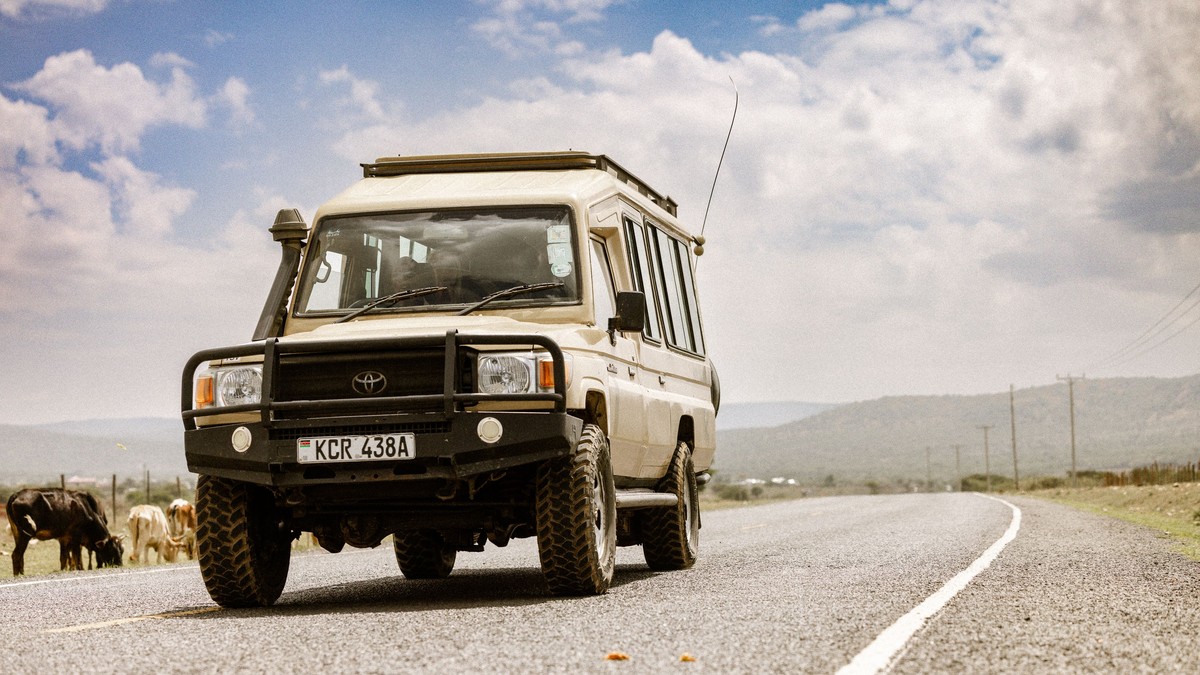
Every reputable camp and every Valley Safaris vehicle carries a radio or satellite phone for genuine emergencies, separate from your personal signal. Guides are trained to reach the nearest ranger post, clinic, or flying doctor service even when your phone shows zero bars. This backup system, not your SIM card, is what actually keeps you safe in the truly remote stretches.
The Valley Safaris Difference
We plan connectivity into your itinerary the same way we plan game drives. Before you travel, we tell you plainly which nights you’ll likely have Starlink at camp and which nights you should plan to switch off. We help guests set up a Safaricom SIM or eSIM in Nairobi on day one, not as an afterthought. Our vehicles carry working radios on every single route, including the quieter corners of Samburu and Tsavo. Our guides have driven these roads for years, so when a guest asks “will I have signal tonight,” we give a real answer, not a guess.
FAQ
Should I get a Kenyan SIM or use an eSIM? Get a physical Safaricom SIM if your trip is longer than a week or you want M-Pesa access. Use an eSIM if you value convenience over local payment features.
Is Safaricom or Airtel better for safari coverage? Safaricom, without much debate, especially outside major towns.
Do lodges have Wi-Fi fast enough for video calls? Some do, thanks to Starlink, particularly in the Mara and Laikipia. Many still don’t. Ask before you book if this matters.
What if there’s an emergency with no phone signal? Camps and vehicles carry radios or satellite phones specifically for this, independent of mobile networks.
Plan your connected, or disconnected, safari with us
If you’d like an honest breakdown of where you’ll have signal and where you’ll truly get to unplug, we’re happy to walk through it. Take a look at our Kenya safari tours or reach out through our contact page to start planning your trip.